Add private AI to your clients without moving their data.
Your clients are asking for AI. Most options put their data on somebody else’s platform—your liability, not your margin. Kirk deploys our AI platform inside the cloud account your client already owns, and operates it after go-live. You keep expanding the relationship.
We work with a small number of partners at a time, so flawless delivery is assured.
AI is arriving in your accounts. With or without you.
Clients are buying AI tools on their own and asking you to make them safe. Saying no sends the conversation to somebody else. Saying yes usually means reselling a platform where your client’s documents live on a vendor’s infrastructure, priced per seat, on a bill that grows every time somebody new logs in. It’s a service you support, a risk that lands on you — and one you profit very little from.
What your clients need,
and where you win.
Four things a private AI platform must get right before you should can put your name next to it. Software without services is not a solution.
Their data, security, and tenancy
The client’s data stays in the client’s own cloud account. Nothing moves to a vendor.
Their usage costs grow predictably
Driven by concurrency, not token costs. Costs are predictable and lower.
They own the AI, you own the relationship
Supporting and growing your client relationship is your job, operating the AI Platform is ours.
Nothing you do today is displaced.
Your help desk, network and security services stay exactly where they are or gets better.

The open-source Private AI Platform built for partners.
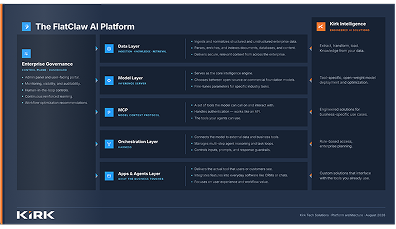
FlatClaw is an AI workforce that arrives finished and stays operated. The client owns a running system and the source. Together, we partner to keep it performing and improving.
- Everything a Private AI Platform needs, pre-integrated
- Single-tenant. Customer-owned. End-to-end.
- Completely auditable, mechanically provable.
- Price is based on tenant, not usage. One flat monthly rate.
Deep AI expertise.
Deep engineering expertise across AI: cloud infrastructure, data modernization, secure cloud architecture, enterprise integration and AI deployment governance. Focused on getting AI into production and improving outcomes over time.


Keith Gutfreund
Veteran systems architect and large data expert with decades of experience across distributed systems, enterprise infrastructure, AI platforms, embedded systems, and cloud modernization, with multiple patents in search and Big Data and deep involvement in large language models and search technologies since the late 1990s.


Skyler Truax
Enterprise AI architect specializing in secure AI integrations, MCP systems, scalable deployment pipelines, and enterprise modernization, with deep expertise in Big Data and Maintainer of Flatclaw, the open-source private-cloud AI cowork harness & platform.
Start with one account. We do the heavy lifting.
One workflow, one account
Pick a client and a single back-office workflow with a number attached — document processing, intake, reconciliation. We scope it together.
We deploy into their tenancy
We stand it up in the client’s own cloud account, take the security review, and document what was built.
We operate, you expand
We run it and report against the measure agreed at the start. You bring the next workflow, and the next account.
We work with a small number of partners at a time, so flawless delivery is assured.
We do not sell what you sell.
Our expertise at these four disciplines — data modernization, secure cloud architecture, enterprise integration and AI deployment governance — pointed at one job: getting AI into your client’s production environment and evolving it over time.
That is the layer most AI projects fail on, and it sits next to the work you already do rather than replacing it.
- The relationship. You introduce us, you stay in the room, and you keep the account.
- Your service lines. We do not sell help desk, network management, or security operations.
- The renewal. Our work makes your managed contract harder to leave, not easier.
The questions partners ask first.
Whose cloud account does it run in?
Your client’s, on the cloud they already buy from you: an Azure subscription, an AWS account, a Google Cloud project, or a GPU in their own building for data that cannot be in any cloud. They hold the account and the bill, and we deploy into it. Nothing about the platform or the model sits in a Kirk account or a vendor’s. The platform is open source and the documentation ships with the build, so a client who ever wants to take it in-house can, and a partner who wants to run it for them can too.
Who owns the client relationship?
You do. You introduce us, you stay in the room, and the account, the renewal and the first call when something changes stay yours. We do not sell help desk, network or security operations, and we are not building a services arm that will. Our job is to make the managed contract you already hold harder to leave.
Who operates the system after launch?
Kirk, by default. Tuning, connector work, model upgrades, security patches and day-to-day operations are ours under a subscription, reported against the measure agreed at the start. Your team keeps everything around it: identity, network, backup, monitoring and the client conversation. Partners who would rather operate the platform themselves can; it is the same open-source system either way, and we train your engineers as part of the handover.
Which AI models does it use?
Whichever the client approves, running as a file on a GPU they own, not as a service somebody else meters. The default general model today is Google’s Gemma 4 31B, open weights, on one dedicated GPU in the client’s tenant with a quarter-million tokens of context; it is the same model, on the same class of card, in every production system we run. When a job wants something else, we use something else: a small open model where small is enough, specialist speech models for voice, a flagship-class open model such as GLM-5.2 for the hardest reasoning. The platform does not change when the model does.
Does this compete with our Microsoft or cloud practice?
No. It runs on the cloud the client already buys from you or through you, and the GPU, storage and network consumption sit in their account, under your practice. Copilot stays where it is: it is a per-seat assistant inside Microsoft 365, and FlatClaw is a platform for agents that work across the client’s systems and data at a flat rate. Clients who have both use both, and the cloud line item grows on the bill you already manage.
What does a first engagement look like?
One workflow, one client, about six weeks to a working deployment. We scope it together and agree the measure before we start. We stand the platform up in the client’s account, take the security review, build the first agent and document what was built. Fixed scope, fixed price, quoted after a short discovery. You bring the next workflow and the next account, and both ride on the tenant the client already pays for.
How do partners get paid?
In writing, before any client conversation. Two shapes so far. Referral: you introduce, we deliver in the client’s account, and you earn on the introduction. Resale: the platform becomes a line item on your agreement, you buy it at a flat cost per tenant and set your own price, standalone or bundled, and we build the workflows and train your engineers. Project and recurring revenue are shared, and the split is agreed per partner. Ask us and we will be specific.
Why open-weight models instead of ChatGPT or Claude?
Because an open-weight model is a file. It does nothing until you run it, it runs where you put it, and nobody can change it, meter it or train on what passes through it. That is the privacy claim, and it is mechanical rather than contractual: your client’s documents, prompts and transcripts never leave their account, and you can prove it with a packet capture on the segment.
Can our clients' developers use it for coding?
Yes, and we do. FlatClaw’s agent harness is built on the same minimal open coding-agent core our own engineers work in every day: an agent on a loop that reads a repository, changes code, runs the tests and goes again, on private inference, with the repository never leaving the client’s tenant. Code is where open models have closed the gap fastest. GLM-5.2, MIT-licensed with a million-token context, is the one we keep a build recipe for, and we benchmark candidates against the client’s own repositories before choosing.
What does it cost the client, and how many people can it serve?
One GPU per tenant, about two thousand dollars a month of cloud at published list rates, billed by their cloud provider on their own account, and every workflow on it at that one flat rate. Kirk’s subscription for operations and upgrades sits on top and is quoted per tenant. There are no per-token, per-minute or per-seat charges from us, ever.
What happens when a better model comes out?
We swap it. The platform does not change; the model file does, and model changes are ours to make and report on under the subscription, which includes a twice-yearly inference review whose job is to find exactly those opportunities. A client who standardizes on the platform is not standardizing on this year’s model, and neither are you.
Start with one account.
Tell us about a client who is asking about AI and cannot put their data on somebody else’s platform. We will tell you honestly whether it is a fit. We are based in Portsmouth, NH, so we can be in the room when you need us there.
We work with a small number of partners at a time, so flawless delivery is assured.
Still undecided? Wow, you’re tough.
Enterprise Guide to Private AI
Rethinking open weight models
AI use cases of real world situations

Kirkie: Get today’s AI News in under 90 seconds