Enterprise AI has entered a new phase.
For the past two years, organizations have focused on experimentation—testing copilots, evaluating foundation models, building proofs of concept, and exploring new use cases. Public cloud played a critical role in enabling this wave of innovation, providing rapid access to compute, models, and AI services.
But production AI is fundamentally different from AI experimentation.
When AI becomes embedded in business operations, customer experiences, internal workflows, and decision-making systems, infrastructure choices become strategic business decisions. Questions about cost, governance, data ownership, integration, and operational control move from the IT department to the boardroom.
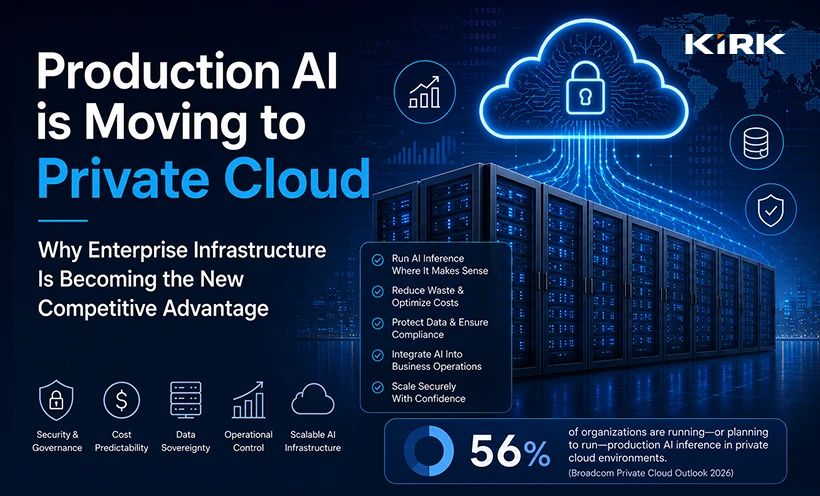
Recent research from Broadcom’s Private Cloud Outlook 2026 highlights this shift. Based on a survey of 1,800 senior IT decision-makers worldwide, the report found that 56% of organizations are running—or planning to run—production AI inference in private cloud environments, while public cloud use for production inference declined from 56% to 41% year over year.
The message is not that public cloud is disappearing.
The message is that enterprises are becoming far more intentional about where AI workloads run—and why.
At Kirk Tech Solutions, we believe this represents a larger transition:
The next phase of enterprise AI will be defined not only by access to models, but by ownership of the infrastructure, data, governance, and operations that make AI work at scale.
AI Is Becoming an Infrastructure Challenge
The first generation of enterprise AI projects often focused on models:
- Which LLM should we use?
- Should we use a hosted API or open-weight models?
- Which AI platform is best?
These remain important questions.
But as organizations move from pilots to production, new questions emerge:
- How do we control infrastructure costs?
- Where does enterprise data reside?
- How do we govern AI systems?
- How do we integrate AI into existing operations?
- How do we scale securely?
These are infrastructure questions.
Broadcom’s research suggests that enterprises are already adjusting. Security, cost predictability, performance, sovereignty requirements, and operational control are increasingly influencing workload-placement decisions.
This shift is particularly important for AI inference.
Unlike experimentation, production inference can create sustained demand for compute, storage, networking, GPUs, monitoring, security, and data movement. AI systems often operate against sensitive information and become integrated into business-critical processes.
As AI moves deeper into operations, enterprises need more than models.
They need production-ready infrastructure.
The Economics of AI Are Changing Cloud Strategy
One of the most significant findings in the Broadcom report is the growing concern around cloud economics.
For the first time, cost overtook security as the top public cloud challenge. The report found that 97% of IT leaders believe some portion of their public cloud spending is wasted, and more than half estimate that waste exceeds 25% of total cloud spend.
AI amplifies this challenge.
Inference workloads increase demand for:
- GPU capacity
- High-performance storage
- Data transfer
- Network bandwidth
- Security tooling
- Observability platforms
- Model serving infrastructure
The issue is not that public cloud lacks value. Public cloud remains highly effective for experimentation, elastic workloads, and specialized services.
However, enterprises are increasingly evaluating whether sustained AI workloads require a different operating model—one that offers greater predictability and tighter alignment between infrastructure investment and business outcomes.
This is one reason workload repatriation is accelerating.
Broadcom found that 50% of enterprises have already moved some workloads from public cloud to private environments, while 33% are considering repatriation—meaning 83% have either already repatriated workloads or are considering doing so. Notably, AI training, large language models, and inference appeared as a repatriation category for the first time in the 2026 research.
This is not a rejection of public cloud.
It is the emergence of a workload-centric strategy: placing each workload where it performs best economically, operationally, and securely.
Data Sovereignty Is Becoming an AI Requirement
AI introduces another challenge that extends beyond infrastructure economics: control.
AI systems increasingly interact with:
- Customer information
- Financial data
- Intellectual property
- Operational systems
- Internal knowledge repositories
- Regulated data
As organizations deploy AI into core business processes, they need visibility into:
- Where data resides
- Who can access it
- Where models execute
- How information moves
- Which policies apply
Broadcom found that data sovereignty and residency requirements are now the leading geopolitical factor influencing IT strategy, cited by 54% of respondents. Four out of five IT leaders say geopolitical and regulatory concerns are affecting infrastructure decisions.
This is particularly relevant as enterprises move toward agentic AI systems capable of accessing tools, triggering workflows, and interacting with business applications.
Governance cannot be an afterthought.
It must be built into the architecture from the beginning.
Where FlatClaw Fits Into the Private AI Equation
As enterprise AI evolves from chatbots to AI coworkers and agentic systems, infrastructure becomes increasingly important. These systems can access enterprise knowledge, work with files, interact with applications, invoke tools, and automate workflows.
AI is no longer simply generating answers—it can become part of how the enterprise operates. That makes data, security, governance, cost, and infrastructure ownership strategic considerations.
FlatClaw: Private AI Built for Enterprise Control
Kirk Tech Solutions’ FlatClaw Private AI Coworker Platform is an open-source, private-cloud platform designed for private, single-tenant deployments within a customer’s dedicated environment.
Its architecture emphasizes:
- Customer-owned cloud deployment
- Dedicated cloud or bare-metal infrastructure
- Single-tenant architecture
- Dedicated GPU infrastructure
- Predictable infrastructure economics
- Data remaining within the customer’s environment
- Persistent organizational AI memory
- Enterprise integrations and RBAC
- Open, auditable frameworks
FlatClaw also supports integrations such as Google Workspace and Jira, along with custom MCP protocols.
From AI Consumption to AI Ownership
As AI becomes more deeply embedded in enterprise operations, organizations need to think beyond model subscriptions and API consumption.
They need to ask:
Who controls the infrastructure, data, deployment, compute, economics, and auditability of their AI?
This is where FlatClaw fits into the broader shift toward private AI.
Don’t just consume AI. Own the environment in which your AI operates.
The Missing Layer in Many AI Initiatives: Enterprise Integration
A common misconception in AI projects is that deploying a model is equivalent to deploying an AI solution.
In practice, enterprise AI requires a much broader foundation:
Data → Integration → Infrastructure → Models → Security → Governance → Operations
This is where many organizations encounter challenges.
AI often fails not because the model is inadequate, but because:
- Data is fragmented
- Systems are disconnected
- Governance is incomplete
- Infrastructure is not designed for scale
- Operations become too complex
At Kirk Tech Solutions, we approach AI as an enterprise engineering challenge.
Our Enterprise AI Infrastructure framework combines four disciplines:
- Enterprise data modernization
- Cloud and private AI infrastructure
- Enterprise integration
- Secure AI deployment
The goal is not simply to implement AI tools.
The goal is to create an environment where AI can operate reliably, securely, and at scale.
Private AI: From Concept to Operational Capability
The rise of AI agents and AI coworkers is increasing the importance of infrastructure decisions.
Traditional AI systems generate responses.
AI coworkers and agentic systems can:
- Access enterprise knowledge
- Interact with applications
- Execute workflows
- Maintain context
- Support employees across departments
As these capabilities mature, organizations need greater control over how AI operates inside the enterprise.
This is the thinking behind FlatClaw, Kirk Tech Solutions’ private AI coworker platform.
FlatClaw is designed for organizations that want to deploy AI within infrastructure they control, while maintaining flexibility around models, integrations, security policies, and governance requirements.
Rather than treating AI as an external service, private AI platforms enable organizations to align AI capabilities with enterprise architecture, operational requirements, and data policies.
This approach is increasingly relevant as enterprises seek to balance innovation with control.
The Future Is Not Public Cloud or Private Cloud
One of the most important conclusions from the Broadcom findings is that enterprises are moving away from one-size-fits-all cloud strategies.
The future is not:
Public cloud versus private cloud.
It is:
The right workload on the right platform.
Public cloud remains valuable for:
- Innovation
- Experimentation
- Elastic capacity
- Specialized services
Private infrastructure becomes increasingly attractive for:
- Predictable AI inference
- Sensitive workloads
- Regulated environments
- Business-critical applications
- Data-intensive operations
- Agentic AI systems
Leading enterprises will combine these approaches to create hybrid environments that balance flexibility, economics, governance, and control.
Building the Foundation for Production AI
The organizations creating the most value from AI are not necessarily those with access to the largest models.
They are the organizations building:
- Modern data foundations
- Secure infrastructure
- Strong governance
- Integrated systems
- Scalable operating models
AI is no longer simply a software initiative. It is becoming part of enterprise infrastructure.
And infrastructure decisions increasingly determine whether AI remains an experiment—or becomes an operational capability.
At Kirk Tech Solutions, we help organizations move beyond pilots by designing and implementing enterprise AI environments that combine infrastructure, data, integration, security, and governance.
Because successful AI deployment is not only about choosing the right model. It is about creating the right foundation.
Source Note
This article draws on findings from Broadcom’s Private Cloud Outlook 2026: The AI Tipping Point, a global survey of 1,800 senior IT decision-makers. The analysis and perspectives presented here are those of Kirk Tech Solutions and are not affiliated with or endorsed by Broadcom.
References
- Broadcom, Private Cloud Outlook 2026: The AI Tipping Point.
- Broadcom announcement: Broadcom Private Cloud Outlook 2026 announcement
- VMware report page: Private Cloud Outlook 2026 report
- Kirk Tech Solutions Enterprise AI Infrastructure: Enterprise AI Infrastructure
- Kirk Tech Solutions FlatClaw Private AI Platform: FlatClaw Private AI Coworker Platform