A conversation every CEO, CIO, CTO and business leader should have before scaling AI
Table of Contents
- Start With the Business Decision
- Where Your AI Should Live?
- Your AI Is Only as Reliable as Your Data
- A Successful Demo Is Not a Successful System
- AI Changes the Cloud and IoT Conversation
- Five Questions to Ask Before Approving an Enterprise AI Initiative
- The Next AI Advantage May Be Operational
- The Bottom Line
If you are responsible for technology at your organization, you have probably had some version of this conversation already.
Someone comes into the room excited about a new AI capability. The demonstration is impressive. People immediately start talking about what the organization could automate, how much time it could save, or what competitors might already be doing.
Then someone asks the question that changes the conversation:
- What happens if we actually put this into the business?
- Where does the data go?
- Who has access?
- What happens to confidential information?
- How does it connect to the systems we already use?
- Who is responsible when it gets something wrong?
- What happens when usage grows?
- What does it cost?
- And perhaps the question executives care about most: What business problem are we actually solving?
Those are not anti-AI questions. They are the questions that make an AI strategy real.
At Kirk Tech Solutions, we have spent years working on complex technology problems across cloud, data, IoT, enterprise systems, and AI. Our perspective has become fairly simple:
The technology is important. But the decisions around the technology are more important.
Start With the Business Decision
Let’s imagine your organization is considering an AI initiative.
The natural starting point might be:
Which model should we use?
We would suggest starting somewhere else:
What decision, process, or outcome are we trying to improve?
That sounds obvious, but it changes the project.
If the goal is to reduce the time employees spend searching for internal information, the challenge may be knowledge access and data integration.
If the goal is to automate document-heavy work, the challenge may be workflow design, document quality, permissions, and exception handling.
If the goal is to give employees an AI assistant, the real issue may be identity, access control, enterprise knowledge, and governance.
The model is part of the solution. It isn’t necessarily the solution.
Where Your AI Should Live?
This is becoming an increasingly important executive question.
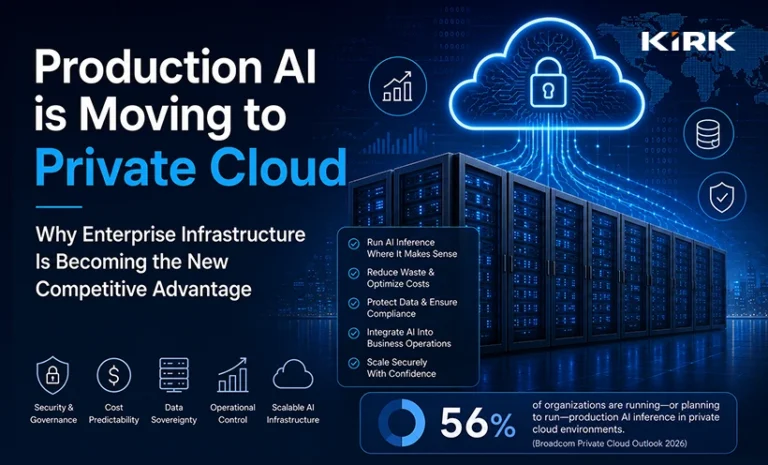
For some applications, using a public AI service may be entirely appropriate. For others, leadership may want substantially more control over the environment in which AI operates.
That can be driven by sensitive intellectual property, customer information, regulatory requirements, internal policy, security considerations, cost predictability, or simply a desire to retain control over an organization’s technology strategy.
This is where private AI becomes interesting.
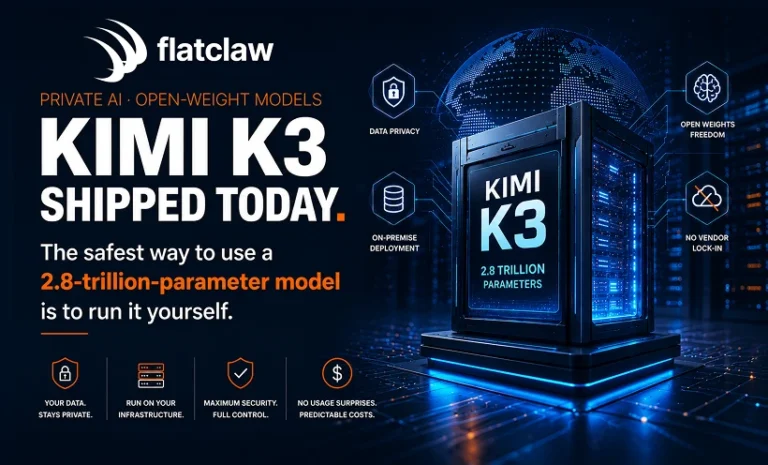
At Kirk, we’ve developed FlatClaw around the idea that organizations should have an option to deploy AI within infrastructure they control.
The point isn’t that private AI is automatically better. The point is that architecture should be a business decision, not an assumption.
Executives should be able to ask:
- What information is leaving our environment?
- What information must stay inside it?
- Who controls the infrastructure?
- How do we govern access?
- What happens if our provider changes pricing or capabilities?
- What level of vendor dependency are we comfortable with?
Those are strategic questions.
Your AI Is Only as Reliable as Your Data
Here’s another conversation worth having before approving a major AI initiative:
How much do we trust our own data?
Most large organizations have accumulated technology over many years.
There are modern applications alongside legacy platforms. There are cloud systems alongside on-premises infrastructure. There are databases, spreadsheets, SaaS applications, departmental tools, and systems created through acquisitions.
The information may be valuable. But it may not be consistent.
One department may define a customer differently from another. Two systems may contain different versions of the same information. Access permissions may have evolved over years. Important knowledge may exist only in someone’s experience.
AI doesn’t make those problems disappear. If anything, AI can make the consequences more visible.
That’s why we believe an AI roadmap should include a serious conversation about data architecture, governance, ownership, quality, and integration.
Not because those topics are exciting. Because they determine whether the AI can be trusted.
A Successful Demo Is Not a Successful System
This is one of the biggest differences between experimentation and enterprise deployment.
A demo asks: Can we make it work?
A production system has to answer: Can we depend on it?
Those are different questions.
A production AI system has to coexist with real people, real infrastructure, real security policies, real budgets, and real consequences.
- The API will eventually fail.
- The data will eventually be messy.
- Someone will eventually ask a question nobody anticipated.
- A model will eventually change.
- A permission will eventually be wrong.
- A business requirement will eventually change.
That isn’t pessimism. That’s engineering.
The strongest technology organizations don’t design around the assumption that everything will go perfectly. They design systems that remain useful when it doesn’t.
AI Changes the Cloud and IoT Conversation
The Cloud Conversation Has Changed
AI is forcing organizations to revisit decisions they thought they had already made about cloud.
Many enterprises aren’t operating a single, clean cloud architecture.
They have inherited environments. An acquisition brought one platform. A development team adopted another. A legacy workload remained somewhere else. A SaaS application became business-critical. A new AI workload introduced another set of infrastructure requirements.
How do we put everything in one place?
The better question may be:
What architecture gives us the right combination of control, flexibility, security, performance, and cost?
That requires looking at the entire environment rather than treating each technology decision as an isolated purchase.
IoT Is a Data and Integration Challenge
The same principle applies to IoT.
Connecting a device isn’t necessarily the difficult part. The executive questions come afterward.
- What happens to the data?
- Where is it stored?
- How is it secured?
- Who can access it?
- How does it connect to the organization’s other systems?
- How do people act on the information?
- And what happens when the deployment grows from a handful of devices to thousands?
The device is only one part of the system.
The real value often comes from what the organization can do with the information generated by that device.
That’s why we tend to think about IoT as an enterprise data and integration challenge, not simply a connectivity challenge.
Five Questions to Ask Before Approving an Enterprise AI Initiative
If you are sitting with an executive team evaluating a significant AI investment, answer these five questions before spending too much time on models.
1. What Business Outcome Are We Buying?
If we can’t explain the outcome, we may be buying technology rather than solving a problem.
- Can we describe the intended result in business terms?
- Time saved?
- Revenue generated?
- Risk reduced?
- Customer experience improved?
- Operational capacity increased?
2. What Information Will the System Need?
Identify the data before designing the AI.
- Where is it?
- Who owns it?
- How reliable is it?’
- Who can access it?
- What information should the AI never see?
3. Where Should the System Run?
There isn’t one universal answer. The answer should reflect the organization’s risk, regulatory, security, operational, and financial requirements.
- Public cloud?
- Private cloud?
- On-premises?
- A hybrid architecture?
4. What Happens When Things Go Wrong?
- What is the fallback?
- Who reviews exceptions?
- How do we monitor the system?
- How do we audit activity?
- How do we change the system?
- Who owns it after launch?
5. What Will Success Look Like Six Months From Now?
Not six days. Not the day of the demo. Six months after launch.
- Are people actually using it?
- Is it producing the expected outcome?
- Is it costing what we expected?
- Has it reduced workload or created another operational burden?
- Can the organization maintain it?
Those answers tell you whether you’ve built a capability or simply completed a project.
The Next AI Advantage May Be Operational
There is a lot of discussion about which organization will have the best AI.
The more interesting question is: Which organization will be best at operating AI?
The advantage may not belong exclusively to the company with the newest model. It may belong to the company that can take AI and integrate it into the way the business actually works.
That requires good data. Good architecture. Good governance. Good engineering. Good judgment. And a willingness to say no when an AI project doesn’t make business sense.
That’s the conversation we want to have with executives.
Not: “Look what AI can do.”
But: “Here’s the business problem. Here’s what we know. Here’s what we don’t know. Here are the architectural choices. Here’s the risk. Here’s the investment. And here’s how we’ll know whether it worked.”
That is a much more productive AI conversation.
The Bottom Line
AI is not going away.
The question for leadership isn’t whether to participate. It’s how to participate without losing control of the things that matter.
At Kirk, our job is not to convince every organization to use every new technology.
It’s to help organizations make better technology decisions.
- Sometimes that means AI.
- Sometimes it means fixing the data first.
- Sometimes it means changing the architecture.
- Sometimes it means private infrastructure.
- And sometimes the right answer is to wait.
The technology will continue to change. The executive responsibility doesn’t.
Understand the problem. Understand the risk. Understand the economics. Build what makes sense. Then make sure it works in the real world.
That is what practical AI means to us.
And that is where we believe the next breakthrough will come from.
About Nate Tennant
Nate Tennant is Founder and CEO of Kirk Tech Solutions, founded in 2006. He leads the company’s work across enterprise AI, private AI, cloud, data, IoT, and complex technology initiatives, with a focus on practical solutions and long-term business value.
Kirk Tech Solutions Recognition
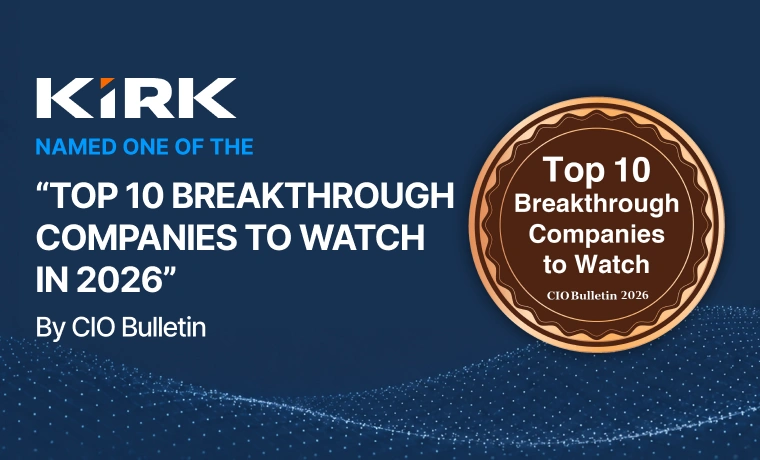
CIO Bulletin named Kirk Tech Solutions one of its Top 10 Breakthrough Companies to Watch 2026. We appreciate the recognition, and see it as an opportunity to continue the conversation around practical, operational AI for enterprise organizations.
Read the CIO Bulletin recognition: https://ciobulletin.com/magazine/profile/top-10-breakthrough-companies-to-watch-2026-listing
Read the CIO Bulletin interview: https://ciobulletin.com/magazine/profile/kirk-tech-solutions-delivering-innovative-technology-solutions