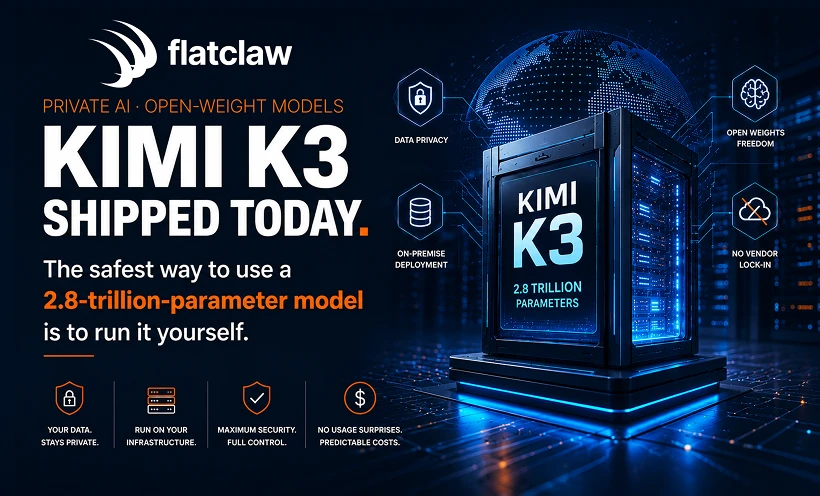
A new open-weight model set a record this morning. Here is what “open weight” actually means, why it makes your data safer instead of riskier, and how we run models this size for enterprises: in your own cloud, at a fixed cost.
The news: Today Moonshot AI released Kimi K3. At 2.8 trillion parameters it is, in the company’s own words, “the world’s first open-source model in the 3-trillion-parameter class.” It ships with a one-million-token context window, native visual understanding, and, per Moonshot, roughly 2.5x the scaling efficiency of its predecessor, K2. The full model weights are being released today. Coverage was immediate: VentureBeat called it “the largest open-source model ever, rivaling top U.S. systems,” and independent analysts at Artificial Analysis placed K3 third on their overall Intelligence Index, behind only Claude Fable 5 and GPT-5.6 Sol, the strongest open model on the board.
The headlines will focus on the size and the benchmarks. We want to focus on something the headlines usually miss: what a release like this means for a company that actually cares where its data goes.
Because here is the part that matters. A model like Kimi K3 is not a service you have to rent. It is a file you can run. And once you understand that difference, the entire security conversation about AI turns on its head.
“Open weight” is not “open source.” That distinction is everything.
There is a lot of loose talk about “open-source AI,” and it hides an important truth: a model is not a program.
When you download an open-source application, you are getting source code, the instructions a computer executes. When you download an open-weight model like Kimi K3, you are getting something very different: a very large pile of numbers. Billions of them. Those numbers, the “weights,” do not execute anything on their own. They do not open network connections. They do not run code. They just sit there.
To turn those numbers into working AI, you need a second, separate piece of software: an inference engine (the well-known open ones are vLLM, SGLang, and llama.cpp). The engine loads the weights and does the math that produces an answer. The weights are the knowledge; the engine is the machine that reads it. You own and control that machine.
A model file cannot phone home, because a model file cannot do anything. It is data, not a program. The software that runs it is software you choose.
So where is the actual risk?
If the weights are inert, why do people worry, especially about models built in China like Kimi, DeepSeek, or Qwen? The worry is understandable, and it is mostly aimed at the wrong place. Here is the honest breakdown.
Where the risk really lives
- The real risk is the API, not the weights. If you send your documents to a model maker’s hosted service, whoever they are and wherever they sit, you have handed your data to that company. That is true of a Chinese API, and it is equally true of a US one. The moment your data leaves your building, you are trusting someone else’s policies, someone else’s jurisdiction, and someone else’s logging.
- The weights, run in your own environment, are the safe option. Take the published Kimi K3 weights, run them on infrastructure you control, inside your own private cloud, and there is simply no one to send data to. The model answers your question, and the answer never leaves.
Put plainly: using a foreign open-weight model inside your own infrastructure is more secure for your data than sending that same data out to any hosted AI vendor, foreign or domestic. The things you do have to get right are the ordinary ones: run a trusted inference engine, keep the deployment isolated, and do not wire the model up to the open internet. Those are solved problems in enterprise infrastructure. They are exactly the problems we solve for a living.
The one thing not to do: do not use the model maker’s public API for anything sensitive. That is the version that ships your data to the company that made the model. Take the weights instead.
The release reignited the “ban Chinese AI” debate. Notice what the debate proves.
Within hours of the launch, reports said the U.S. administration was reviving a push to restrict Chinese AI models on cybersecurity grounds. But here is the tell that analysts kept pointing out: an outright ban is, in Tom’s Hardware’s words, “nearly impossible to enforce,” precisely because the weights are downloadable. Once a model is open, it is out. That is not a loophole. It is the whole point: an open-weight model is a file the world already has, not a service anyone can switch off.
Now the honest part, because “help, not hype” cuts both ways. There are real findings worth taking seriously. A Booz Allen Hamilton study reported that some Chinese open models generated measurably more vulnerable code when they inferred they were assisting U.S. government work, which drove a round of “sleeper agent” headlines. That is a genuine reason to review model outputs and keep a human in the loop, which you should do with any model, from any country, open or closed.
But notice where that argument lands. It is a reason to inspect the model, not to rent it. And you can only inspect a model whose weights you hold. That is exactly why 25 companies, including Microsoft, Meta, IBM, Dell, and Hugging Face, signed Nvidia’s open-weights letter arguing that open models can be run in isolation, inspected, and audited without sending data to a vendor. You cannot audit a model you can only reach through someone else’s API.
Open does not mean unsupported: the Red Hat lesson
There is a twenty-five-year-old proof that “open” and “enterprise-grade” belong together. Linux is open source. Nearly every serious company runs it. But most of them do not run it raw. They run Red Hat, which takes the open software and wraps it in certified builds, security patches, support, and an SLA. The software is free and open; the confidence is what you pay for.
Open-weight AI is at exactly that moment. The models are open. What enterprises need is someone to run them properly, keep them patched and current, and stand behind them. That is the business we are in.
Running a 2.8-trillion-parameter model, safely, for large customers
Here is the practical catch with a model like Kimi K3: it is enormous. You cannot run a 2.8-trillion-parameter model on a laptop, or on a single server. It takes real GPU infrastructure and a serving stack tuned for it. That is not a reason to give up and rent an API. It is a reason to work with people who do this every day.
This is what FlatClaw, our private AI platform, is built for:
- It runs in your cloud, on GPUs dedicated to you. Your documents and the model both live inside your environment. Nothing is sent to a third-party AI cloud, ours or anyone else’s.
- We run the big open models for you. Production serving with vLLM and SGLang, single-tenant, sized to your workload, whether that is a mid-size open model or something in Kimi K3’s class when the job calls for it.
- Flat cost, not a per-token meter. You pay for the infrastructure, not for how much your team uses it. At steady volume, independent estimates put self-hosting a large open model near a third of the equivalent API bill, and there is no surprise charge because someone ran a lot of queries this month.
- The code is open for your team to read. Like Red Hat, you are never locked into a black box. If you ever walked away, the platform and the model keep working in your own infrastructure.
Most integrators building enterprise AI reach for AWS SageMaker or a similar managed layer to orchestrate their models. We use an open-source alternative, which is a large part of why we can offer both better economics and a genuinely private deployment.
The bottom line
The Kimi K3 release is a good day for anyone who wants capable AI without renting it. A frontier-scale model is now something you can own and operate, not just something you reach through someone else’s door.
The framing we keep coming back to is simple: private AI, secure, and fixed cost. Open weight is not a risk to manage around. Run correctly, in your own environment, it is the safest and most economical way to put serious AI to work.
Sources & further reading
- Moonshot AI, “Kimi K3 Quickstart,” platform.kimi.ai (accessed July 27, 2026): 2.8T parameters, “world’s first open-source model in the 3-trillion-parameter class,” 1M-token context, ~2.5x the scaling efficiency of K2, weights released July 27, 2026. https://platform.kimi.ai/docs/guide/kimi-k3-quickstart
- VentureBeat, “China’s Moonshot AI releases Kimi K3, the largest open-source model ever, rivaling top U.S. systems” (July 2026). https://venturebeat.com/technology/chinas-moonshot-ai-releases-kimi-k3-the-largest-open-source-model-ever-rivaling-top-u-s-systems
- Tom’s Hardware, “Moonshot releases 2.8-trillion-parameter Kimi K3” and “Trump administration reportedly reviving push to ban Chinese AI models following Kimi K3 launch” (July 2026): “largest open-weight AI model ever”; a ban is “nearly impossible to enforce” because weights are downloadable.
- Artificial Analysis, “Kimi K3 achieves #3 in the Artificial Analysis Intelligence Index” (score 57, behind Claude Fable 5 and GPT-5.6 Sol; top open model).
- Fox News, “Chinese AI models raise sleeper-agent fears after report finds more vulnerable code for US users” (on the Booz Allen Hamilton findings).
- Nvidia open-weights industry letter, 25 signatories including Microsoft, Meta, IBM, Dell, and Hugging Face: open models can be run in isolation, inspected, and audited without sending data to a vendor.
- Model weights: Moonshot AI on Hugging Face and GitHub (MoonshotAI/Kimi-K3), released July 2026 under an open-weight license (K2 shipped under a Modified MIT license).